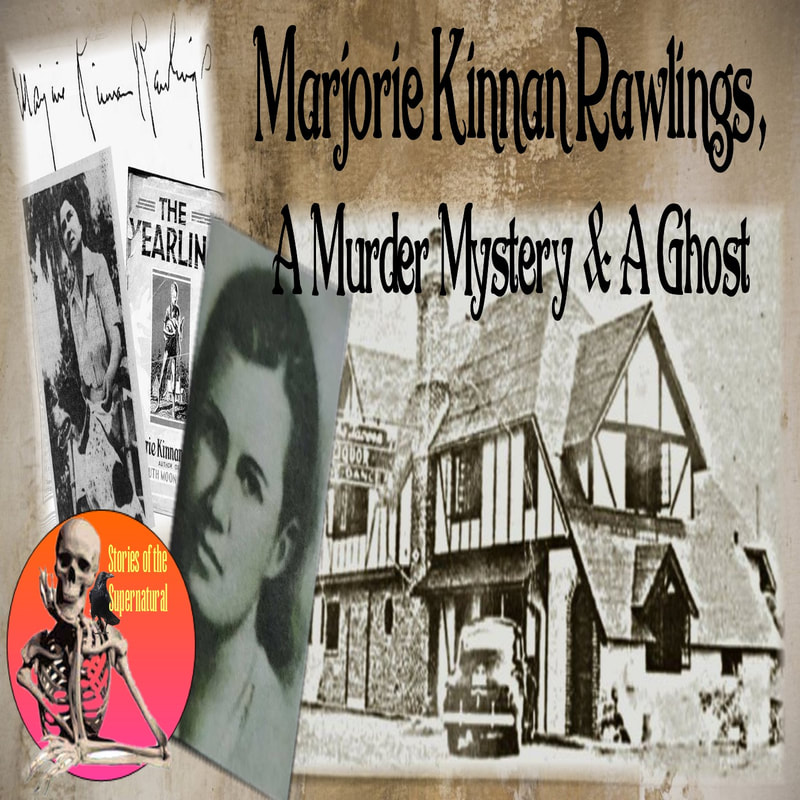




Marjorie Kinnan Rawlings lived at Cross Creek, rubbing elbows with the Florida Crackers and moonshiners and producing beautiful literature.
Marjorie Kinnan
MARJORIE KINNAN RAWLINGS
Marjorie Kinnan was born in 1896 in Washington D.C. Her father Arthur Kinnan was an attorney for the U.S. Patent Office. In 1919, she married Charles Rawlings and in 1928 with an inheritance from her mother Ida, they bought a 72-acre grove near a hamlet named Cross Creek, located between Lochloosa Lake and Orange Lake, Florida. The acreage cost them $14,000 and had 52 acres planted with orange trees, and 20 acres in pecans. Charles Rawlings had two brothers who owned a gas station in Island Grove. When the Rawlings moved to Cross Creek it was a poor, rural, lakeside community. Its residents survived by fishing, hunting, planting kitchen gardens and tending orange groves. The house on the homestead had seen better times. It was built around 1880, then two tenant houses were moved and attached to its side. Historic preservation experts believe the house was originally built as a two-room cabin with a "dogtrot," or a breezeway running through the house from front to back. Additional bedrooms were built in the 1890s, while a dining room and kitchen were added in the 1920s. There was no electricity or an indoor bathroom. Marjorie Kinnan with her husband Charles Rawlings c.1928
The first year they came to Cross Creek, Charles Rawlings went to Tarpon Springs and spent 6 months on a sponge boat, writing a story for Collier's magazine. This was a thriving industry in the area, and Greek divers and crew were recruited to bolster the workforce.
Perhaps his decision to take such a lengthy assignment was a sign the marriage was troubled, since they separated in 1928, however they did not divorce until 1933. Charles did not appreciate rural living quite as much as she did. With the proceeds from her first story Jacob's Ladder, Marjorie paid for an indoor bathroom in 1931. It was the first of its kind in Cross Creek, and she held a party to celebrate it. Her neighbors, colloquially known as Florida Crackers soon warmed to her. She incorporated the landscape and the poor backcountry residents into her short stories. Reception to her stories was mixed, since some of them didn't realize she was describing them, and one mother recognized her son and threatened to whip Rawlings until she was dead. MK Rawlings hunting with her hound
Her neighbors, colloquially known as Florida Crackers soon warmed to her. She incorporated the landscape and the poor backcountry residents into her short stories. Reception to her stories was mixed, since some of them didn't realize she was describing them, and one mother recognized her son and threatened to whip Rawlings until she was dead.
Ironically Rawlings was known to curse as good as the men, and drank and smoked in an era when this was considered unladylike. She once shot 32 rattlesnakes in the woods near Arcadia. Inbetween her writing, Rawlings rode horseback through her farm, and worked the orange groves. She went hunting through the land with a hound close by. Leonard Fiddia and his mother Piety who Rawlings stayed with while researching her first novel c.1930s
Like many writers, inspiration for their greatest creations arrive through ordinary circumstances. Such is the story of the interaction between Rawlings and Leonard Fiddia and his family.
These were the years of Prohibition and Rawlings got her moonshine from stills in the Ocala National Forest. She hid a five-gallon jug in the house's attic. Marjorie bought moonshine from Leonard Fiddia, but also helped him make it. In 1932-33 she spent several weeks with him and his mother Piety to gather material for her first major novel, South Moon Under. The story set at Cross Creek, is about Lant a young man who supports himself and his mother by selling moonshine. It was a finalist for the Pulitzer Prize. Marjorie Rawlings met Leonard Fiddia in either 1929 or 1930 while on a hunting trip with a mutual friend. It was Leonard Fiddia who introduced her to Calvin Long in the “Big Scrub.” Calvin Long shared with Marjorie the story about his brother Melvin, who had a pet deer. From there the classic story was born. Leonard Fiddia lived off of Hog Valley Road by the Ocklawaha River. The Yearling is the novel that propelled M.K. Rawlings to fame c.1938
M.K. Rawlings stayed living at Cross Creek during the Depression, writing on a screened-in front porch on a Remington (Royal) typewriter. She hired neighbors to wash, cook and clean while she wrote. The original typewriter was stolen after her death, but the table, which was a circle of cypress atop a cabbage palm trunk is the original one she used, and is part her home which is present day a historic state park. Her husband had originally made it to play poker on, but she took it over two weeks after he finished it. Next to the typewriter is an ash tray. She would smoke up to 3 packs of Lucky Strike cigarettes per day.
Next to her typewriter she had a narrow daybed where she would nap on the porch. She dedicated herself to write 8 to 12 hours per day.
In the autobiographical Cross Creek, Rawlings described how she hired several people over the years to help her with day-to-day chores. She hired Beatrice on and off for two years. She was nicknamed Geechee since she was descended from the Gullah people. Blinded in one eye from a fight, her mother lived in nearby Hawthorne. During one of her stints working for Rawlings, Geechee asked her for help in gaining release for her boyfriend who was serving time in prison for manslaughter. Rawlings sponsored Leroy to work on her farm as a parolee. Geechee and Leroy celebrated their wedding at Marjorie's house, but no good deed goes unpunished, and a few weeks later Leroy threatened Rawlings for more earnings. Marjorie Rawlings ordered him off the property, but asked Geechee to stay with her, which she did. However Rawlings became aware of something she had not realized before, which was that GeeChee was an alcoholic, who had been drinking from her store of moonshine hidden in the attic. She tried to compromise with Geechee, urging her to drink less during the day. "We compromised by parceling it out, but it was never enough. Her grief, her burden, was too great." Finally Geechee procured a gallon of her own, got roaring drunk and simply walked away. Rawlings wrote an entire chapter in Cross Creek about Geechee: "No maid of perfection—and now I have one—can fill the strange emptiness she left in a remote corner of my heart. I think of her often, and I know she does of me, for she comes once a year to see me" Norton Baskin, M.K. Rawlings second husband
In 1938, The Yearling was published, and it won the 1939 Pulitzer Prize. The novel propelled her to fame, and it would go on to be translated into 16 foreign languages. Fame though drove her inside her bedroom, when too many curious people showed up at her front door.
The novel immortalized Cross Creek as "Yearling Country". That same year she sold the rights to MGM for $30,000. MGM released the film in 1946 starring Gregory Peck, Claude Jarman and Jane Wyman. It was nominated for five Academy Awards, and won two Oscars for art direction and cinematography. Rawlings married Norton Sanford Baskin in 1941, and they bought the Castle Warden in St. Augustine. It was built in 1887, as the winter home for Standard Oil executive William Warden. Built in a distinct Moorish style, Norton who was a hotelier, planned to renovate the old mansion and run it as the upscale Castle Warden Hotel. Baskin joined the American Field Service in 1943, and served as an ambulance driver in the Burma/India theater of war. During the years of World War II, Rawling continued to run the farm at Cross Creek and oversee the hotel. In March, 1944 two women guests lost their lives in a blaze at the Castle Warden hotel. Ruth Pickering, who lived in a penthouse on the top floor of the hotel, and Elizabeth N. Richeson from Jacksonville could not escape the third floor. Other guests were able to get out. M.K. Rawlings and her husband had occupied the penthouse until he joined the American Field Service. She had moved to Cross Creek at this time. It was believed a cigarette caused the fire. In 1950, M.K. Rawlings and her husband sold the building, and it was made into the Ripley's Believe it or Not Museum, which it still is present day. The couple lived mainly at a cottage Rawlings had bought in Crescent Beach that was about 10 miles south of St. Augustine. She later bought an old farmhouse in Van Hornesville, New York, and she would split her time between both properties. He would stay behind to run the hotel. She wrote her last book The Sojourner during her stays at the farm. The story was not set in Florida, and received mixed reviews. By the time she bought the house in New York her infatuation with Florida had grown stale. Zelma Cason
The end of Rawlings’ love affair with Cross Creek started when her neighbor Zelma Cason sued her for invasion of privacy in 1943. Cason was the one who helped her soothe over the problem with the mother of the son depicted in Jacob's Ladder who wanted to thrash her to death.
The women had become fast friends, and Rawlings had helped Zelma Cason take the 1930 census. They rode horseback into the remote areas of Alachua County, much of which was inaccessible by automobile. The county was dotted with turpentine camps. In April, 1942 Rawlings went by Cason's boarding house on Anastasia Island to give her an autographed copy of Cross Creek, Cason told her she didn't want it. In 1943, Cason filed suit against Rawlings and her husband Norton Baskin. Rawlings thought she had a good friendship with Cason and immediately went to speak to her. The two women spoke, and Rawlings thought things were fixed between them. When she attempted to give Cason a copy of Cross Creek Cookery, Cason reportedly cursed her and threw the book to the ground. Cason went forward with a lawsuit for libel and asking for $100,000 but it was changed to invasion of privacy. Twelve years after they rode into the Florida backwoods, the two women had become enemies. The passage that Zelma Cason sued her over described the character in the book as: "Zelma is an ageless spinster resembling an angry and efficient canary. She manages her orange grove and as much of the village and county as needs management or will submit to it. I cannot decide whether she should have been a man or a mother. She combines the more violent characteristics of both and those who ask for or accept her ministrations think nothing at being cursed loudly at the very instant of being tenderly fed, clothed, nursed, or guided through their troubles." In 2008, a commemorative postal stamp was issued for Marjorie Kinnan Rawlings
Cason was represented by J.V. Walton and his daughter "Miss Kate" Walton of Palatka (1917-1985), one of the first women admitted to the Florida Bar in 1936.
Testimony was given that confirmed that Cason was indeed a very profane person, which one of the neighbors said could be heard for a quarter of a mile swearing. Surprisingly despite her use of "profane language" she was referred to by the local newspapers as one of Island Grove's society ladies. It took 3 years before the case went to trial. When Marjorie arrived at the courthouse with her husband, she was overheard to say, "Now I know how Antionette felt in the tumbril." M.K. Rawlings in her garden
Philip May and Sigsbee Scruggs represented Rawlings. Scruggs had represented many residents of Cross Creek, some on charges of hog stealing, moonshining, alligator poaching and even incest. He was hired just to pick the jury for the defense.
Rawlings testified for two days, and the jury found for her in less than 30 minutes. A total of 51 persons testified to the accuracy of the descriptions in her book. For Rawlings what was at stake, besides avoiding to pay damages, was the belief that a writer should have the freedom to describe accurately the world around them as they saw it. Cason appealed and the state Supreme Court reversed the decision Ultimately Rawlings was ordered to pay damages in the amount of $1.00 and $1050 in court costs. The case had dragged through the court for over 5 years. The battle cost Rawlings $32,000 in legal fees. M.K. Rawlings signing books
The case took a toll on Rawlings in both time and emotion, and she felt betrayed by Zelma Cason. She never wrote another book about Florida, even though she'd been considering writing a sequel to Cross Creek.
In the aftermath of the trial, Zelma Cason claimed the lawyers had dragged her into the lawsuit, and they in turn said she had approached them. One has to wonder if Cason's sudden enmity to Rawlings was fueled by her marriage in 1941 to Norton Baskin, and spending time away from her Cross Creek property. In February 1952, Rawlings suffered a heart attack when she was alone in Cross Creek. Upon her death in 1953, from a cerebral hemorrhage she donated her property to the University of Florida, Gainesville where she taught creative writing. By then the property included 125 acres. In 1971, the State of Florida took over the Cross Creek property, and declared the home a historic site. Much of the furniture in her home are replicas, however the Singer sewing machine, her bureau, the couches are her original possessions. Tom Glisson with his wife Pearlee and son J.T. c. early 1930s
Her husband Norton died in 1997, and they are buried side by side at Antioch Cemetery near Island Grove, Florida. Towards the end of his life he admitted he had made a mistake in burying Marjorie in Antioch Cemetery, when she had asked to be interred in the Citra Cemetery.
The story he told was that Tom Glisson was buried in Citra. He had been their neighbor and friend and also a character in the book Cross Creek. When they attended his funeral in 1950, Marjorie told him this is was where she preferred to be buried. However when she died, he believed the cemetery was closer to the Cross Creek property. He didn't realize the mistake until they arrived at the cemetery to bury his wife. J. Tom Glisson was one of five families living in Cross Creek when Rawlings moved there. He was a farmer and citrus grower, and he testified at the court proceedings that the author had depicted him accurately, and he had not been offended. He also stated her description of Zelma Cason was accurate. Cason who never married died in 1963, and was buried 20 feet away from Rawlings in Antioch cemetery. Ironically her tomb is inscribed with "immortalized in the writings of Marjorie Kinnan Rawlings." Between 1912 to 1949 Marjorie Kinnan Rawlings published 24 short stories and 11 novels and story collections, most of them set in North and Central Florida.
The following took place in Rockledge, Florida, just southeast of Alachua County. It started as a murder mystery, and became a ghost story that persists until today.
Marjorie Kinnan Rawlings had just written her first novel in 1933, when a grisly murder was discovered not too far from Cross Creek in November, 1934. Ethel Cool Allen, 18, had disappeared. READ THE STORY HERE:
0 Comments
Your comment will be posted after it is approved.
Leave a Reply. |
Stories of the Supernatural PodcastStories of the Supernatural listen to episodes without commercial interruption on your browser or download the mp3 file
Marlene
|
||||||


RSS Feed