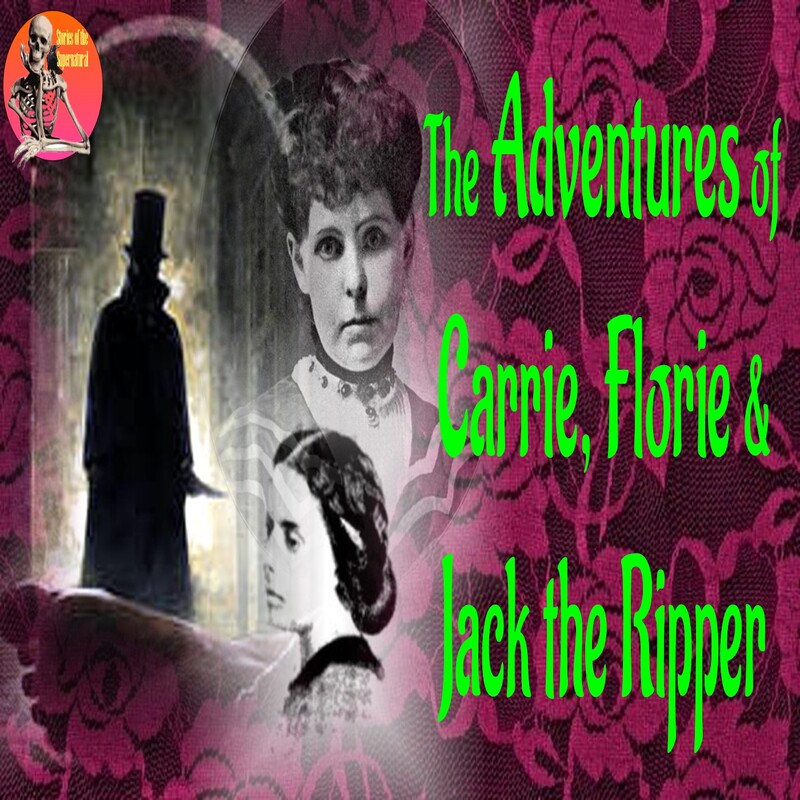




Caroline "Carrie" Holbrook and her daughter Florence "Florie" Chandler, moved in the highest circles of American and European society. As Victorian ladies they were taught to run from any hint of scandal, but by the time they passed from this life their names were linked to infidelity, secret marriages, murder and even Jack the Ripper. | Host and Narrator - M.P. Pellicer | www.MPPellicer.com
Caroline Holbrook Chandler
During her youth, Caroline Holbrook raised eyebrows, and only her family ties and wealth kept her from being completely ostracized from polite society. However it was not until her daughter, Florence Chandler Maybrick was accused of poisoning her husband that the rest of the world learned of several, sordid stories she thought had long been buried. The implications of the newspaper articles were obvious, which was the apple doesn't fall far from the tree.
Caroline Holbrook was born in 1838, to Darius Holbrook and Elizabeth Ingraham. Both of her parents could trace their family history back to the 17th century and pre-revolutionary times. In 1856, she went to visit her uncle Rev. Joseph H. Ingraham in Mobile, Alabama. This was when she met her first husband William Chandler who was the head of the St. John Powers & Co. a famous banking house. They married in 1857, and within a year she gave birth to their son Holbrook. Caroline Chandler was described as a "brilliant society woman, stylish, though not pretty." In 1862, William Chandler who was only thirty-two years old fell ill. Caroline tended him at their home and none of his relatives were permitted to see him. He died on July 8, 1862. She was eight months pregnant with their second child Florence, who was born in September. Postcard of the Chandler Mansion, 256 Government Street, Mobile, which later became the McGill Institute
There are different stories as to what took place after Chandler's death. The family grew suspicious and supposedly made life so impossible for Caroline that she left for Macon, Georgia. Some say their hostility toward her was due to the fact that she was a Northerner, and Alabama was part of the Confederacy during the Civil War.
Allegedly Caroline claimed her young husband died because of the anxiety he felt due to his responsibilities as head of the St. John Powers & Co. In his will, Mr. Chandler urged his wife to return to New York, but that his son should be raised by his maternal grandmother. Caroline Chandler did not comply with either of these wishes. Instead she went husband hunting. Some versions said that Caroline met Captain Franklin DuBarry while she was still married as he was a friend of the family, and another placed their meeting later when she left for Macon, Georgia. They might have met when she worked at a Civil War hospital in Charleston. Wherever the truth lies, less than two years later she married Captain DuBarry. Here again there is a divergence of stories. In one version, Captain DuBarry was sent to Europe representing the Confederate army, possibly to buy ammunition. The second story is that he headed to the Bahamas to improve his health since he suffered from consumption Steamboat Fanny
The DuBarrys along with the children left on the steamship Fanny, which managed to get away from the blockade vessels stationed off the coast of Wilmington. In the early hours of May 27, 1864, one hundred and fifty miles out to sea Captain DuBarry became ill. The 26-year-old was a dead man by the end of the day.
The Dubarrys were a prominent family. His deceased father Dr. Edmund Dubarry (1797-1853), had served as the United States Navy Surgeon. It was said the captain of the ship wanted to return to Wilmington so DuBarry could be interred on hallowed ground. However Caroline DuBarry insisted he should be buried at sea. The notice of his death posted from Nassau a few days later. Dubarry's mother, along with four brothers and one sister were left to mourn over an empty grave. In the span of five years, Carrie Chandler Dubarry had become a bride and widow twice. Frank Armstrong Crawford Vanderbilt (1839-1885), married Cornelius Vanderbilt who was her mother's cousin
Contrary to the saying that you can never go home, Caroline did exactly that. She joined her mother Elizabeth who was by then a widow still living in New York. Her frequent companion was her cousin, Frank Armstrong Crawford Vanderbilt.
The Crawfords were a prominent family in Mobile, Alabama, once the capital of French Louisiana, where wealthy New England Families spent the winter. They built their mansions along Government Street where Caroline had once lived in the Chandler Mansion during her first marriage. Caroline's father Darius Holbrook Jr. died in 1858 leaving an estate valued at $1,000,000 which he divided between his wife and children. By then Caroline decided she wanted to marry someone with a title, and she was duped by Charles Rebello (Revello, Revollot). He convinced her he was an exiled Italian count, and in 1866 they went to Newark, New Jersey and married in secret. Some newspapers confused him with Charles Rebello who served as the British Vice Consul at Cuba in 1861, or another Charles Rebello (1828-1868) who was a reporter for the New York Sun. The most accurate version of his true identity is that he was an actor she had become involved with after she returned to New York. Florence and Holbrook Chandler as children
Rebello wanted wealth, so he gave Caroline what she wanted, and made himself Count Rebello. How long did it take for Caroline to realize the truth is unknown. She claimed during the divorce that he abandoned her within 24 hours of their marriage, and set sail on a ship headed to Venezuela, South America. According to her, they had never consummated the marriage, and that she was unaware that he married her only to gain possession of her lands. This explanation begs the question; why would he leave? Within a year of the marriage she brought suit in Floyd County Circuit Court at New Albany, but it was dismissed on January 4, 1868.
A few days later Caroline Rebello with her mother and her children in tow, established temporary residence in Columbus, Indiana. They were accompanied by two lawyers, Colonel A. T. Hawhee and Colonel Thomas B. Farleigh. Caroline stated that Rebello had compelled her to marry him through duress, fraud and misrepresentation. Within two months the divorce was granted, and the ladies and the children immediately left Indiana. This marriage would be kept secret until her daughter Florence was involved in a scandal many years later. Baron Von Roques c. 19th century
Once free to marry again, Caroline sailed to Europe with her children. There she met Baron Heinrich Louis Adolf von Roques (Von Rorque, Von Roque) a cavalry officer in the Eighth Cuirassier Regiment of the German Army. They married on April 4, 1872 in Wiesbaden Germany. He was born December 22, 1845, and she gave her birthday on the marriage record as February 4, 1846 when in reality the actual birth year was 1838.
Scandal trailed behind Caroline like a faithful puppy. Shortly after her marriage, she confronted her new husband about his infidelities. He beat her, so she left him, but took her title of Baroness with her. After this she allegedly became involved with a Mr. Haggard who was an attaché of the British Legation at Teheran, Persia. He was the brother of Sir H. Rider Haggard who wrote King Solomon's Mines, among other adventure stories. Rumors were they lived as husband and wife, and that he was in full knowledge of her history. The man was probably John George Haggard, since in 1883, he along with Lt. Charles Stewart Smith were appointed to be vice consuls in the dominions of the Sultan of Zanzibar. Years later, J. Treeve Edgcome, Inner Temple, London published a statement given by Caroline, Baroness Von Roques in 1889, who was then living in Rouen, France about the scandal involving her daughter which read: She described where her first husband had died from inflammation of the brain caused by tension and anxiety because of his heavy financial responsibilities his firm had during the Civil War. Eighteen months later she worked at the hospital in Charleston and married Franklin du Barry after he was brought in after sustaining a wound in battle. She along with his brother took him onboard a blockade runner which was chased by US gunboats from Wilmington to Nassau. He died enroute and was buried at sea. In 1873 she married Baron von Roques, who was still alive. She was outraged by the scandal printed that she had been somehow culpable of the death of her first two husbands, which she thought would prejudice her daughter's upcoming trial. She disclosed that she was a member of the American Woman's Masonic Lodge of the Eastern Star under direction of the Grand Masonic Lodge of the New York State. Florence Maybrick
Caroline's brother Darius died in 1875 while in his 30s. That same year her mother, Elizabeth Holbrook, executed a deed trust to her only living child before leaving on a trip to Germany, where she died in 1876. The family home in New York went to her two grandchildren, Holbrook and Florence.
Baroness Von Roques educated her children in Europe, but did visit New York during those years. It was on a trip returning to Europe in 1880, that 18-year-old Florence Chandler met James Maybrick, 43, a wealthy cotton merchant from Liverpool. They married in 1881 and had two children, James in 1882 and Gladys in 1886. Caroline's son, Holbrook St. John Campbell Chandler studied medicine in Paris, but died from a "lingering illness" in 1885, when he was 26 years old. By then Caroline understood too well the cost of marrying for a title. Her husband's creditors after exhausting requests for payment from Baron Von Roques, tried to levy the New York house left to Florence Maybrick by her grandmother. The attorneys Roe and Macklin won the lawsuit for Florence and her brother. They had been handling legal matters for the Holbrook family for many years. The Maybricks to all appearances seemed a happy couple even though there was a 25 year difference between them. During those first years of their marriage Florence learned her husband was a hypochondriac. Eccentricities of this nature could be overlooked, however infidelity was not one of them. James and Florence Maybrick c.1880s
During the first six years of the marriage, Maybrick prospered and paid for his bastard children and his former mistress. According to English law he was responsible for the five children he fathered until they were 16 years old, as well as their mother. Then in 1887, his business declined and when he failed in his payments, the mistress wrote him a letter which came into the hands of Florence. This prompted Mrs. Maybrick to visit a lawyer in London to consult upon a divorce. Perhaps the attorney advised against it, since these were the times where James would be criticized, not for his infidelity, but for the indiscretion in allowing his wife to become aware of his affairs.
A husband could obtain a divorce with only a claim of infidelity; a wife's bar was set much higher. She had to prove desertion, sodomy or other type of deviant behavior in order to secure a divorce, and afterwards a divorcee faced silent, but relentless disapproval from society. Alfred Brierly, Florence's love interest
Whichever the case, she decided to pay her husband back in kind, and started an affair with Alfred Brierley a merchant who ran in their same social circle. Maybrick became aware of it, and his suspicions were confirmed when they attended the Grand National Day at Aintree, and Florence walked up the course with Brierly. All of their friends were present, and this doubled Maybrick's ire. Once home they fought and he struck her. The rift was so deep that Maybrick drew up a new will, leaving everything to his children and excluding Florence.
Dr. Hopper, the family physician was aware that James Maybrick regularly added arsenic to a cup of beef tea, and he also drank a preparation containing strychnine. He had warned him several times against taking these poisons. Michael Maybrick
On May 27, 1889 James complained of feeling sick, and asked for Dr. Humphreys, who regularly attended his children to come see him. He diagnosed Maybrick with dyspepsia and put him on a diet. He got better, returned to work but by the weekend he vomited constantly and complained of pains in his legs, and his hands felt numb. He felt better, however his brother Edwin who was staying at the house brought in Dr. Carter for a second opinion. He concurred with Dr. Humphreys' diagnosis and confirmed that he needed to be meticulous about what he ate.
Mrs. Hughes, a family friend sent a telegram to Michael Maybrick who lived in London. She also told Florence to bring a nurse to look after James. On that day, Florence gave the nanny, Alice Yapp a letter to post. Whether intentionally or by accident, the letter was given to Florence's son to hold, and he dropped it in a puddle on the way to the post office. This allegedly gave the nurse an excuse to open it and clean it up. It was addressed to Brierly, and the intimate words left no doubt about the relationship between them. The nanny gave the letter to Edwin Maybrick, who ironically was also supposed to have been involved romantically with his sister-in-law. The family forbade Florence from tending to her husband, and locked her in the house, while they ransacked every closet and drawer in the house. James condition worsened in the following days, however samples of his feces and urine did not show any trace of arsenic. He continued to worsen and the doctors warned the family recovery was not possible. Supposedly an envelope marked 'Arsenic: Poison For Cats' was found in Florence's room. James Fitzjames Stephen the judge who presided over the Maybrick trial. He equated Florence's infidelity with her being a murderess even though the evidence did not substantiate this.
An autopsy completed on May 13, found James Maybrick had died due to an irritant poison. Traces of strychnine, hyoscine, morphia and prussic acid were found but the latter two were to be expected as they had been contained in the medicines administered to the dead man.
Florence was arrested and her trial started on July 31, 1889. All the doctors that testified agreed his death had been caused by gastro-enteritis but couldn't conclude if it was caused by bad food, a chill or arsenic. During the trial Florence Maybrick's New York lawyers brought to light that James Maybrick was addicted to the arsenic habit. This challenged the accusation that Mrs. Maybrick had laced her husband's food with arsenic. They described James Maybrick as a "morphine and strychnine fiend." His addiction stretched back a dozen years. A former valet for Maybrick testified to his habit of eating arsenic. He wrote in the affidavit: "he (James Maybrick) took all kinds of medicines, patented and prescribed, and his room looked like a drugstore." The judge used the disclosure that Florence had an affair with Brierly as proof she was capable of killing her husband. The all male jury returned a guilty of verdict within 45 minutes, and sentenced her to death by hanging on August 26, 1889. Illustration of Florence during her trial for murder
Her sentence was commuted to life imprisonment five days before her execution, and she was sent to Aylesworth Prison to serve her sentence.
During the time of her incarceration, Florence Maybrick received seven offers of marriage. James Fitzjames Stephen, the judge had suffered a paralyzing seizure three years before the trial, and within two years after the trial he was "retired" due to senile decay and sent to an asylum. He died in 1894. Perhaps this explains his inexplicable hostility towards Florence Maybrick. He was rewarded by Queen Victoria with a baronetcy and an annuity of 3,500£. Sir Charles Russell, the Attorney-General in a memorandum to the Home Office pointed out the judge had "passionately invited them to find a verdict of guilty." He made suggestions that had never been advanced by the prosecution, and went out of his way to make misleading references. It was noted in the newspapers after Florence's conviction, "Sir James Fitzjames Stephen, who was much prejudiced against wives suspected of misbehavior, had worked himself up into a kind of frenzy when he thought of Mrs. Maybrick becoming a popular heroine." According to the Freeborn County Standard, Minnesota, August 15, 1889: After the verdict became known, thousands of people assembled around the entrance to the court-room and waited for the departure of the judge. As soon as he made his appearance, he was greeted with howls of rage, and the hooting of the crowd was kept up for a long time. There were incessant cries of "Shame," and an attack upon the judge's carriage was only prevented by the active interference of the police. The feeling in Liverpool against the verdict is intense. Steps have been taken to secure a stay of execution on the ground of the discovery of further medical evidence. Baroness Caroline Von Roque
In 1902, Harriet Hubbard Ayer a reporter for the New York World visited Florence Maybrick who by then had served 13 years in prison. She had not seen her children for several years, and did not know of their whereabouts. She then went to visit Baroness de Roques (von Roques) who lived in France. The reporter described where the baroness lived on the outskirts of Rouen in a small house, which she called a "poor little refuge". She had lived there for ten years attended only by one servant. The baron had already died.
Much of their fortune had been spent in defending Florence. During those years a letter was received by the County Clerk for Columbus, Indiana inquiring about a divorce procured by Baroness Von Roques. It was thought that Count Rebello was bringing suit to the divorce granted to Caroline as he was trying to recover an interest in large land estates his wife had in several southern states. The divorce seemed to be legal, since no more was heard of "Count Rebello". In 1903, the Baroness and Florence were about to lose title to over 2.5 million acres in Kentucky, Virginia and W. Virginia valued at over $7.5 million. It seemed their attorney W. D. Armstrong had fraudulently procured their signatures to deeds claiming they were only for a small portion of the lands, when in fact they were for the entire holding. He had given the women only $3,000. Gladys Maybrick and her brother James Chandler "Bobo" Maybrick c.1880s
Florence Maybrick was released in 1904 at the age of 42. She served 15 years in Woking and Aylesbury Prisons. This was just in time so she could sign papers that would allow her attorneys to prevent the loss of these tracts of land.
She returned to America and wrote a book, Mrs. Maybrick's Own Story: My Fifteen Lost Years and lectured upon her experience during her incarceration. She never saw her children again who were given to Dr. Charles Chinner Fuller (1828-1902) and his wife Gertrude (1848-1935) to raise. Her mother Caroline died in 1910, and was buried next to her son in the Passy Cemetery in Paris. For many years, Florence's whereabouts were unknown. Her fortune was gone, and some believed she lived as an indigent in Chicago. In 1918, she was referred to Henrietta Banwell who wanted a housekeeper in Gaylordsville, Connecticut. With donated funds she built a small cabin on Old Stone Road, and told everyone her name was Florence Chandler. Her true identity became known when she gave a black lace dress to Genevieve Austin, a neighbor who found a ticket inside the box with the name, "Florence Maybrick". This was an old, expensive gown far beyond the means of Florence. Florence Maybrick when she was older and living in Connecticut
A librarian was contacted, who told them the story of the scandalous trial from thirty years before. In an act of kindness they did not divulge her true name. Florence became more withdrawn and only allowed cats inside her cabin.
By 1926, she seemed to be suffering from some type of dementia and lived in squalor. Only through the kindness of her neighbors did she get firewood, and help during the Great Depression. In 1941 she fell ill, and Pop Conkrite a neighbor would check on her. She was found dead on October 23, 1941 by Conkrite. She had died from acute myocarditis. It was then those who knew her real identity revealed the truth, and the press revisited the case. They wrote about how she had been shamefully treated by the English legal system and the Victorian mores of the day. Article detailing James Maybrick's (Fuller) accidental poisoning c.1911
Florence's son James, started to use the surname of his adopted parents, Fuller. He moved to Canada and went to work as a mining engineer in British Columbia. In 1911, when he was 29 he accidentally took a swallow of cyanide instead of water and died.
Her daughter Gladys married Frederick Corbyn in 1912. She died in 1971, age 84. James Maybrick attained public attention as the reputed author of a diary found in the old Maybrick when it was being renovated in the 1990s. Diary of Jack the Ripper was written about the possibility this was indeed a legitimate admission of the psychopath who killed prostitute in White Chapel. It has been proposed that the true author of the diary was Michael Maybrick, who used his brother's death as an opportunity to plant a decoy for his own doings. Michael died in 1913, and his brother Edwin in 1928. One has to wonder what would have been the fate of Florie Maybrick and her children, if this diary would have been discovered 100 years earlier. Florence Maybrick during the time of the trial
One of the suspects believed by many to be Jack the Ripper was named Aaron Kosminski. He was a Polish Jewish barber who worked in Whitechapel where the murders took place. He was admitted to a mental institution in the early 1890s, shortly after the Whitechapel murders. He died in 1919, at age 53.
In January, 2025, researcher Russell Edwards claimed he has a "100 per cent DNA match" linking Aaron Kosminski to Jack the Ripper. The DNA was taken from a blood-stained shawl found on Catherine Eddowes' body in 1888. This item was purchased at an auction by Edwards in 2007. DNA analysis found a match for both the victim and Kosminski on the shawl. Comments are closed.
|
Stories of the Supernatural PodcastStories of the Supernatural listen to episodes without commercial interruption on your browser or download the mp3 file
Marlene
|


RSS Feed